 Having trouble with the 5.13 cracks of El Cap's Salathé Headwall? Skip those pesky cracks and clamber straight up the smooth granite next to them! Taking their cue from the amazingly sticky feet of gecko lizards, researchers at the Stuttgart National Academy of Visual Arts came up with this self-contained climbing apparatus. It adheres to glass, metal and concrete, holds up to a ton, and gives two hours of climbing time. When you need to free up your hands, you just clip in to a couple of big gecko paws with daisy chains. A0, baby! OK, so the thing weighs 25 kg (55 pounds) and would never fit into the Harding Slot. It was designed with firefighting and rescue, building maintenance, and military operations in mind, not for rock climbing. But I'm revising my Christmas list right now.


Friday, December 09, 2005
Gecko Man


Wednesday, December 07, 2005
Public Lands: Keep Your Eye on the Ball
Frankly, I have a hard time caring about the Forest Service's interim decision to allow advertising inside chairlifts at ski resorts. Yeah it's crass, but the way people are up in arms, it's as if we were talking about corporate logos in unspoiled wilderness. These are ski resorts, people. They've already trashed the wilderness.
Far more insidious and potentially destructive are two other government efforts to commecialize public lands:
1. The director of the National Park Service, responding to perennial funding shortfalls, has proposed increased corporate sponsorship of parks, including selling naming rights for trails, benches and other facilities. The proposed rules don't allow renaming the parks themselves (think: "Disneystone, formerly known as Yosemite Valley"), and I have no doubt that well-meaning park managers and image-conscious corporate marketers aren't going to spring for "Old Faithful, brought to you by Viagara." (Tip of the hat to PEER for that line.) But unlike the ski-lift ads, this new advertising has the potential to impact previously unspoiled public lands; in my opinion any corporate presence on public lands once you leave a park loop road or BLM parking lot is an unacceptable intrusion of commercialism.
2. Much more potentially destructive is a proposal in Congress to lift a ban on selling public lands to mining companies, under a draft revision of an 1872 mining law. That means, for example, that a mining company could buy a patent on land next to one of the granite crags I frequent in Boulder Canyon and ultimately sell it off to a private developer for new homes. This scenario could be duplicated in countless forms on public lands across the country. Fortunately, this proposal appears to have generated bipartisan opposition as it moves into conference with the Senate, and it seems likely that it will be stripped from any legislation passed, but it may resurface in a different guise as long as the current anti-environment administration and Congress holds power in Washington.
With real threats to the mountain environment surfacing all the time in the halls of Congress, the Interior Department and the White House, it's important to stay focused. I'm headed up to Copper to ski today. Would I care if the chairlifts had ads on them? Not much. I'd really care, however, if the relatively pristine forests and steep mountainsides surrounding this resort were pocked with new commercial developments.
Tuesday, December 06, 2005
Diamond Couloir Still Shining
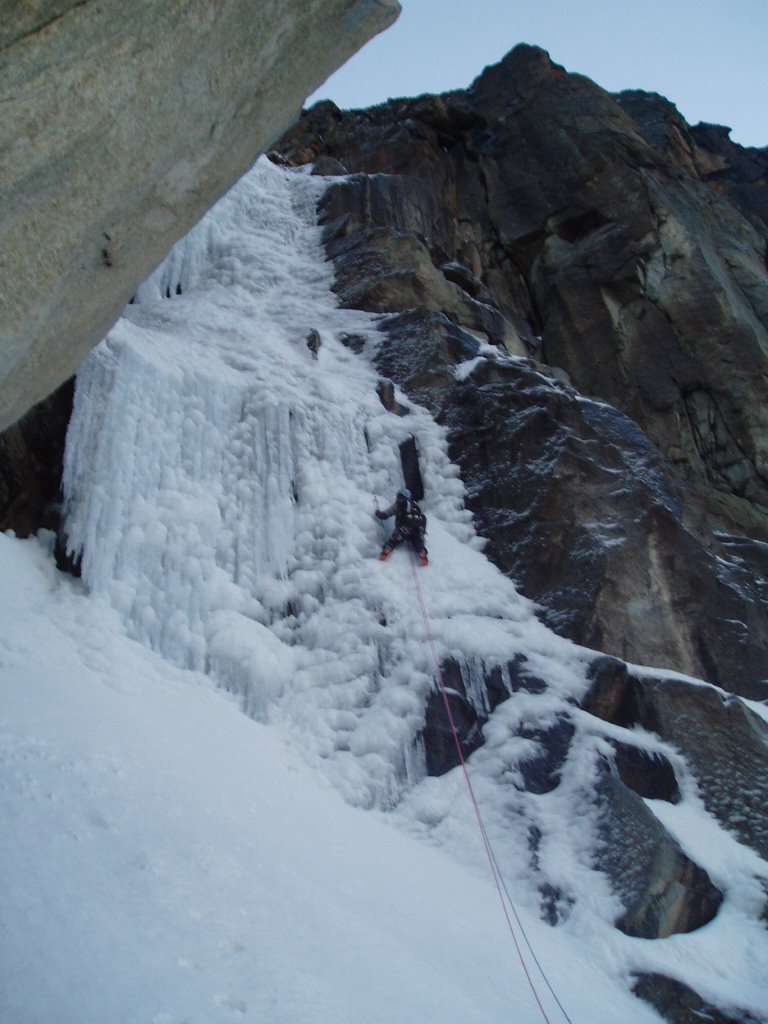 The Diamond Couloir of Mount Kenya, one of the world's greatest ice climbs, was thought to be a victim of global warming, destined not to reappear until the next ice age. This beautiful ice line, which splits the southwest face of the twin-summited peak, was first climbed in 1973 and then made famous by Yvon Chouinard, who pioneered its steep upper headwall two years later. Lately, the line has been deemed unclimbable. But this August, four Americans climbed the route by accessing steep ice with M7 drytooling.
  Jim Donini will have a story about these ascents in Climbing 246, available in mid-January.
Now it seems possible that the fall rainy season on Mount Kenya may be the best time to climb the Diamond Couloir, if you get lucky with the weather. (Most climbers visit the equatorial mountain in the dryer seasons of late summer or midwinter). 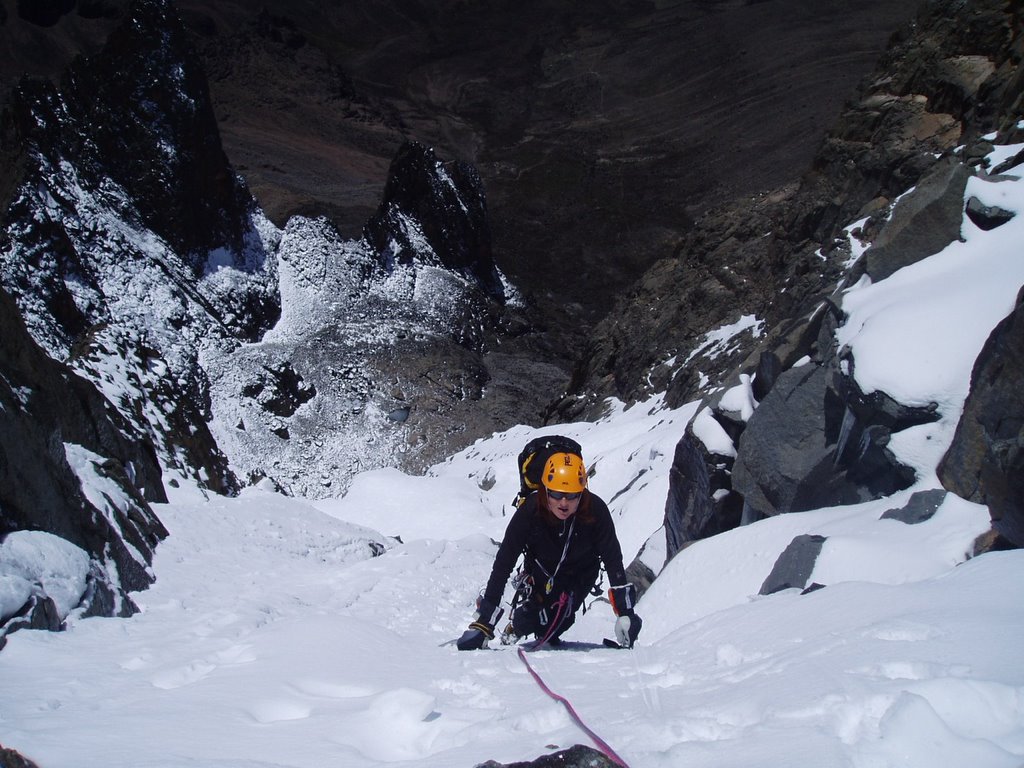
In October, Swiss guide Fred Salamin climbed the route and found great ice the entire way; he sent along these inspiring pictures. This may turn out to be an exceptional year, but for now, at least, it seems the Diamond Couloir has not disappeared.
Sunday, December 04, 2005
Wearable Electronics
 Last month I wrote about Anurag Sehgal's proposed "Modular Wearable System of Mountaineering Devices." But now I see that O'Neill Europe has already announced a solar-powered backpack for skiers and boarders, with slots to integrate an iPod, Bluetooth module and mobile phone; the two plastic solar panels on the back will recharge all the gear. With a mike built into the shoulder strap, headset jack on the chest, and Bluetooth for voice-activated, hands-free calling, you can call Mom and shout "Guess where I am?" just as you jump into Corbett's Couloir. O'Neill's second-generation h2 Comm/Ent Jacket incorporates the same devices, with a flexible control panel sewn into the left sleeve. Gol-dang, Martha, what will they think of next?
Eldorado Gold
Roy Leggett sent an email reporting that in early November Josh Wharton led Extendogap in Eldorado Canyon's Kloof Alcove, the same small crag where Iron Monkey went up in late November. Wharton felt Extendogap was 5.12c R/X. Now, all of the existing lines on this overhanging face have been led. In less than 100 feet, they go 5.11a, 5.12a, 5.12a, 5.12a, 5.12c, 5.14, and 5.12d. Is there anywhere else in North America with such a tight concentration of hard traditional leads?
Friday, December 02, 2005
No More Excuses
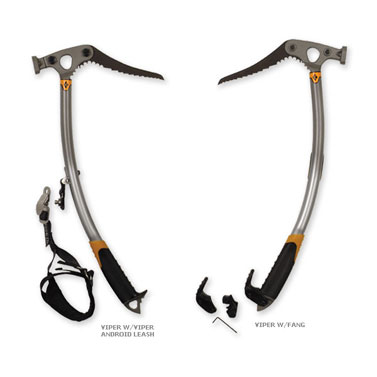 After years of climbing on effective but old-school Charlet Moser Pulsars, I just got a birthday present from my beautiful wife: A pair of Black Diamond Vipers with Fang leashless grips and, for when I need them, detachable leashes. I already love my crampons (Grivel G-14) and boots (La Sportiva K4 S). With all this state-of-the-art gear, this winter I truly have: No...More...Excuses.
New Traditionalists
 I love seeing young rock climbers pursue all aspects of the sport. Nothing wrong with bouldering or sport climbing, but the most interesting climbers to me are the ones who apply their strength and skill to traditional routes, too, whether they're short, hard crack climbs or big walls. So, I was superpsyched to see 21-year-old Matt Segal establish what may be Eldorado Canyon's hardest route in late November and to do it on traditional gear.
 Kloof Alcove is home to the steepest non-roof climbs in the Colorado canyon, with overhanging pitches from 5.11 to hard 5.12, all traditionally protected. For years, the guidebook has pointed out an unclimbed crack on the right side of the alcove. Matt Segal is gym-trained (he's originally from southern Florida), and he's one of the best sport climbers and boulderers in the country, one of three members of the U.S. bouldering team. When he moved to Colorado and had the opportunity to climb real rock, Segal decided he wanted to learn trad climbing too. A couple of years ago, he made the second ascent of the Skip Guerin testpiece Superfly (5.12d R), with a V6 or V7 boulder-problem crux and runout climbing above. Right next to Superfly was the unclimbed crack, and now Segal has climbed that one too. Segal feels Iron Monkey may be as hard as 5.14b, with a 5.12 "approach", a severe dyno crux, and 5.12 climbing above. Segal placed pro on the lead during this proud send. These photos are courtesy of Steve Woods, who witnessed Segal's ascent and then photographed Dave Graham and his son, Daniel, having a go at Iron Monkey with the gear in place. (See more photos at Woods' website). What a beautiful hard line!
Thursday, December 01, 2005
Contrived
 The phrase jump the shark has probably jumped the shark by now, but it still applies to the latest achievement of Ted "Cave Dog" Keizer. Cave Dog is an extraordinary ultrahiker who owns the speed records for hiking the Colorado fourteeners, New Hampshire's White Mountains, New York's High Peaks in the Adirondacks, the Long Trail and others. He's a certified bad-ass. That's why, to me, his latest just seems a bit...contrived.
On Monday, Keizer finished his quest to hike 50 kilometers in 50 states (plus D.C.) in less than 100 days. He ended up doing it in 75. Two signs that this is a new sort of venture for the Cave Dog: 1. The Duofold Hike 50 Challenge, as it became known, got real-money sponsorship, and 2. The hikes were filmed for a TV special on the Outdoor Life Network.
Look, this was an incredible effort, and it's pretty cool that Keizer was emulating the late, great wilderness pioneer Bob Marshall, who apparently had a lifetime goal of doing 30-mile dayhikes in every state. But to me there are two classes of objectives in the outdoors: Natural and unnatural. Natural objectives include logical, coherent goals based on real-world topography, like climbing new routes on all the 8,000-meter peaks or skiing the Colorado fourteeners in a single winter. Unnatural goals are contrived, often to attract sponsorship money, in ways that depend on non-topographic factors such as state borders or personal characteristics like nationality or disability—goals like climbing the high points of the 50 states or becoming the first left-handed person to free the Nose or the first American to climb anything. The latter are great personal achievements and rightfully should be celebrated by the individual and her friends and family. But they don't belong in the record books. Cave Dog's 50 hikes in 50 states must have been a wonderful experience for him, and they may make for good TV, but I hope he'll apply his drive and talent to a more compelling objective next time out.
Skiing the 14ers in a Season
Wild Snow has the news on freeskier Chris Davenport's plan to attempt ski descents of all 54 Colorado fourteeners in a single season. Davenport, a champion extreme skier and ski-flick star, will start January 1 and keep going until he does all the descents or runs out of snow. Naturally, a film is planned. Lou Dawson, who runs Wild Snow, has posted a nice capsule history of recent attempts on the single-season push (scroll down to his November 28 entry). It's a monumental task: No one has come close to climbing all of Colorado's 14,000-foot peaks in a single winter, let alone skiing them too. Davenport isn't trying to finish his descents by March 21—he can keep skiing into July—but it's going to take a lot of mountaineering ability and stamina, along with some great luck with the weather and conditions, to pull this off. Dawson, of course, was the first—and, so far, only—person to ski from the summits of all the fourteeners. It took him 14 years to finish the project in 1991, and this year he was inducted into the Colorado Ski & Snowboard Hall of Fame for the feat. I profiled Lou in the December issue of 5280, focusing in part on his role as a mentor to younger skiers. Although Lou would be the first to say he couldn't teach Davenport a thing about skiing, Davenport has consulted with him this winter on the fourteener project. And, of course, Lou will be in the film.




 Posts
Posts


