Cam Burns, the Bard of Basalt, sent me this nugget from Australia: A 15-year-old boy, climbing with his dad and a guide, aims to be the youngest ever on top of Mt. Everest. The never-ending parade of "firsts" on Everest is astonishing. 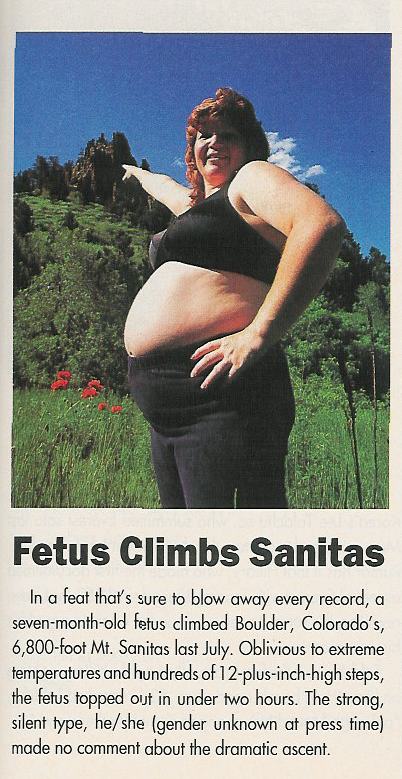 (At R&I, we talked of doing a special Gimps Edition to collect all the First Blind Ascent of This and First Amputee Ascent of That stories that we somehow never got around to publishing.) The youth thing is particularly vexing. One side of me says it simply must be inappropriate to encourage a 15-year-old to climb Everest. But I'm cautious because A) I don't have kids, so what do I know? and B) For every parent-pushed preteen comp climber or Ed Viesturs wannabe trying to grab attention, there's another kid like Tommy Caldwell who started climbing with his dad when he was 3 and seems to have survived the experience just fine. Who knows if young Mr. Harris from Australia is an example of the former or latter?
The little spoof above was my take on the whole subject in R&I's last "Schlock & Vice" edition (September 1995). I couldn't put it any better today.


Thursday, March 16, 2006
The Last Word on Firsts


Wednesday, March 15, 2006
Voiding the Warranty
When I was at Rock & Ice, we used to brainstorm about an article or series called "Voiding the Warranty." It was intended to describe the ways creative climbers modify their gear to make it more effective or useful for purposes the manufacturer likely wouldn't condone: turbo-charging stoves for cold, high-altitude conditions or rigging a Gri-Gri for solo climbing are two good examples. Sadly, it never came to fruition, but British climber Andy Kirkpatrick's Psychovertical.com is taking up the torch.
After only a few months online, Psychovertical is the best source on the web for real-world, hard-knocks technique and gear advice for serious climbers. (Climbing magazine's online Tech Tips sections is also packed with good info but is not as well-organized.) Kirkpatrick specializes in cold, serious climbing: winter climbs in the Alps, Patagonia and Alaska, among other nasty places. Such environments tend to sort out the textbook advice and catalog copy from what really works. Bivouac techniques, climbing as a party of three, hauling a pack, leading with a pack, unusual knots, bad rappel anchors—it's all there. Some of Andy's material will be more useful (and understandable) to Brits and climbers in the Alps than to Americans, but it's all worth a look.
Monday, March 13, 2006
The Mightiest Wind
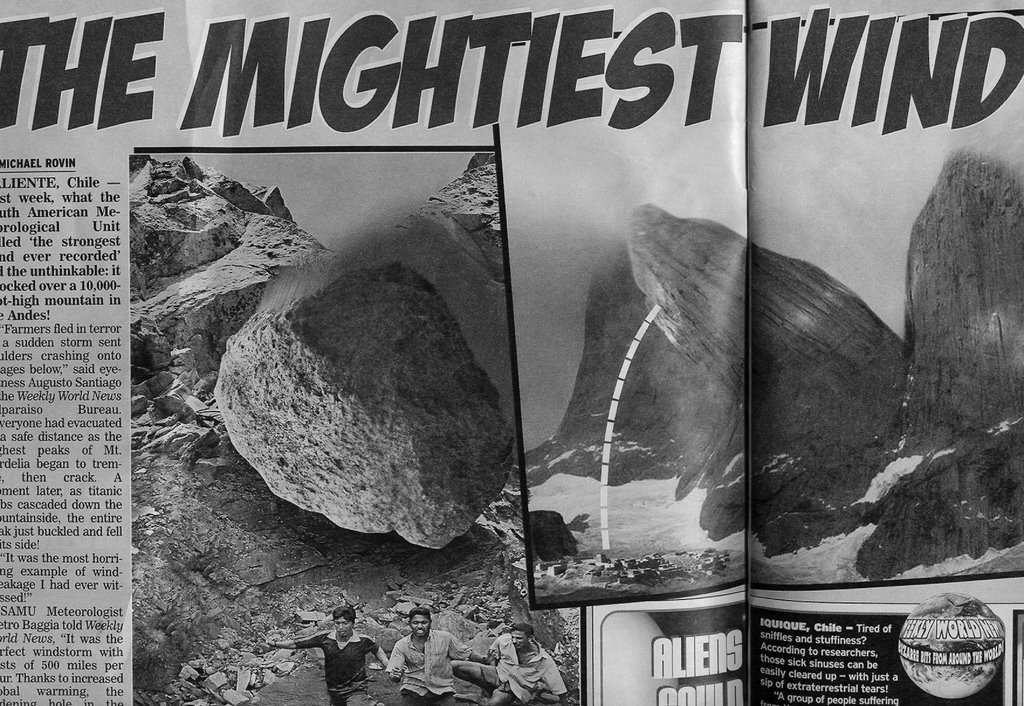 I'm surprised I hadn't heard that the Central Tower of Paine had been blown over by a 500 mph wind. But the Weekly World News (motto: "The World's Only Reliable Newspaper") is on top of the story. Seems the "strongest wind ever recorded" buckled the granite foundation of "Mt. Cordelia," toppling the tower onto the farming village below. I didn't even know there was a village on the glacier below the Torres del Paine, but pictures don't lie, do they? As meteorologist Pietro Baggia of the South American Meteorological Unit (SAMU) told a reporter from the Weekly World News' Valparaiso Bureau, "It was the perfect windstorm with gusts of 500 miles per hour. Thanks to increased global warming, the widening hole in the ozone, and the ocean-disrupting effects of La Niña, we can expect to see an increase in winds of this magnitude. Next time, we may lose an entire mountain range." Consider yourself warned.
Friday, March 10, 2006
More Titan Photos


Steve Levin provided more photos from our climb of the Sundevil Chimney in Utah's Fisher Towers in early February. Since we were trading leads, these shots give some different views of the route's seven pitches for those curious about the climb. 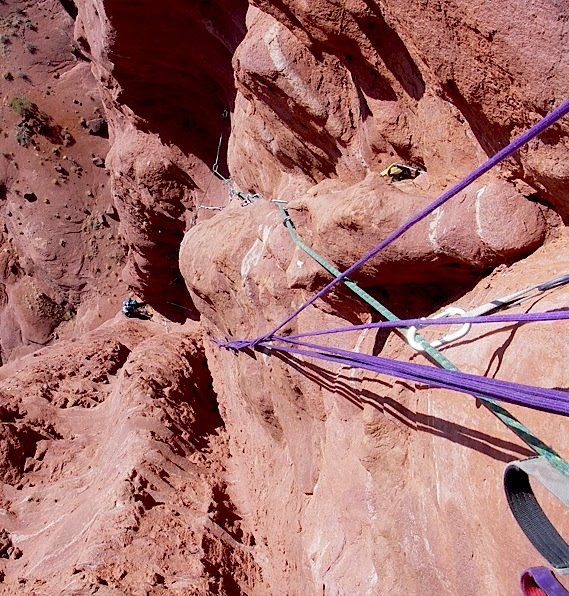 The pics above are looking down the first pitch on Day One and jugging the same pitch on the second day. The next photos are looking down the third pitch, which has some difficult aid at the end of the pitch, and then a butt shot at the crux aid of the fourth pitch, followed by the start of the cool mud stemming section.
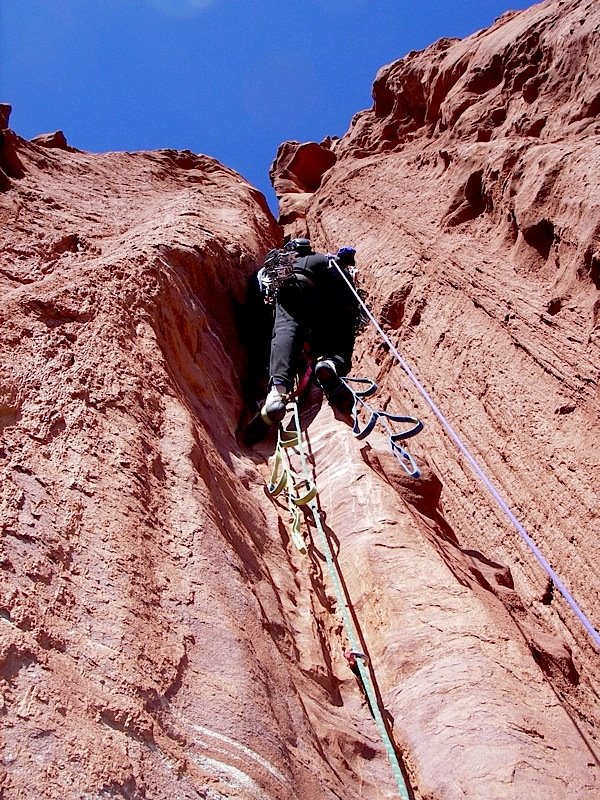
The last climbing shot is taken from the bivy ledge atop the fifth pitch. From here, it seems clear that you must go up into the obvious chimney. Nope. You're supposed to tension traverse straight left from just above where I'm climbing. I headed right and and up into the chimney. Poorly protected free climbing ensued. You can just see the easy exit crack that gains the summit at the top of the photo.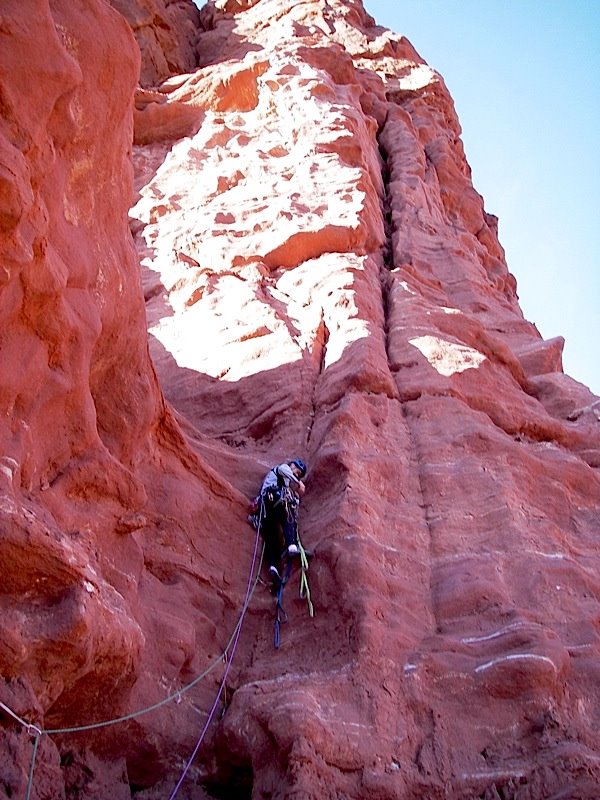
That's Steve on the right in the sunset summit photo and me on the left, thinking, "Hurry up and take the damned picture so we can get the #%&@! out of here!" By the way, I learned (or relearned) something critical during the descent from the Titan: An LED-only headlamp may be fine for approaches and climbing in bright, reflective snow, but it's not sufficient for technical climbing and descents on rock. Those little lights are tempting because they weigh almost nothing, but I'll never do a big rock climb again without a lamp that has a bright traditional bulb.
Thursday, March 09, 2006
Dear Boss: I Quit

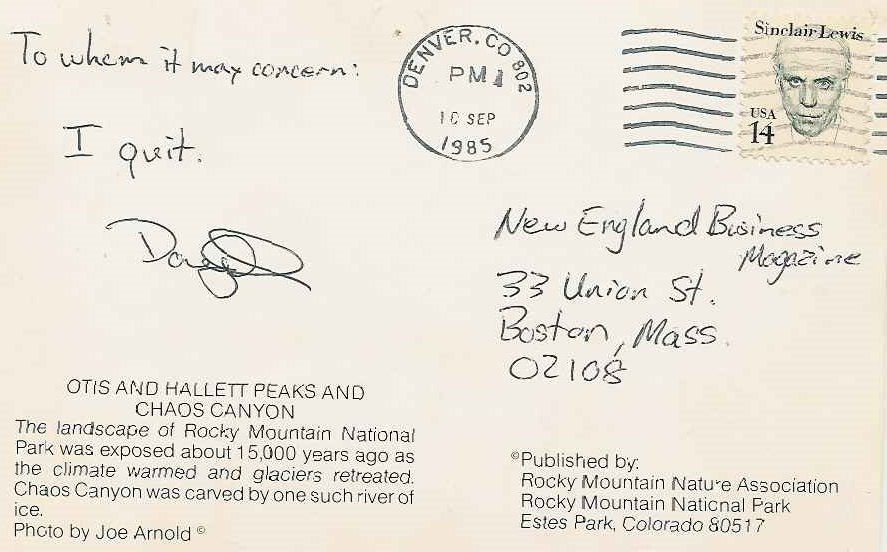 What was I thinking? I sent this postcard near the end of my third trip to Colorado. I was working for a magazine back in Boston, and I wasn't really quitting: I thought my editor would see this beautiful photo of Hallett Peak, know that I was a climber, and understand that this was just wishful thinking and I was just kidding around. A year earlier, I had pulled a similar stunt. I was in North Conway for a weekend of ice climbing, and on Sunday we discovered that the Fang, a rarely formed three-pitch route at Frankenstein, was in good shape. It was too late to climb it that day, so my partner and I made the decision to stay another night. In the morning, I called my boss and left him a message: "I've got a once in a lifetime opportunity today, and I've got to take it!" I hung up, we went and climbed the Fang, and on Tuesday morning I showed up at work to discover that my boss had been convinced I was at a once-in-a-lifetime job interview.
When I returned to Boston after sending this postcard, my editor laughed it off; he wasn't really expecting that I would quit. But the thing is, three trips had revealed the bounty of climbing out west and convinced me I needed to escape rainy New England. Within a few months, I left this job and set out on the roundabout path that led me to Colorado for good.
Tuesday, March 07, 2006
Watch Me!
 Oh yeah, this is the job I want! Spotting competitors at the start of the Ice Climbing World Cup's final route in Hemsedal, Norway. Watch out for those heel spurs, man! (Photo by Dag Hagen, courtesy of www.norsk-klatring.no.) And they say volunteers are hard to find at competitions...
Friday, March 03, 2006
Hamburger Helper
Mark Richey was leading one of the Torpedo Tube offwidth/chimneys on the rough granite of the Nautilus at Vedauwoo, Wyoming. Mark Wilford was belaying. Richey had run out of gear and started wingeing as he squirmed and scraped up the sharp, crystalline rock. "I could deck from here!" he grunted. Wilford replied, "Don't worry, you'll bleed to death before you hit the ground."
Thursday, March 02, 2006
Innovation in Outdoor Gear
There's an excellent article on Backpacking Light about the lack of innovation in outdoor equipment in recent years. The site's editor, Ryan Jordan, writes, "I've come to realize after reviewing hundreds of new products every year that the true test for innovation is simple: the product (or technology) serves more functions better with fewer sacrifices than the products or technologies it intends to replace." He argues, for example, that tube-based hydration systems don't make the grade, nor do soft-shell garments, because each comes with its own set of sacrifices that causes it to fall short of true innovation, compared with the product it's designed to replace. Jordan cites some truly innovative products, such as the superlight Alpacka rafts, along with some that seem to me not so groundbreaking. Finally, in the most interesting part of his story, Jordan and his contributors craft a long list of innovations the outdoor industry has failed to deliver—a fascinating wish list.
Get Outdoors rants that most innovation in outdoor gear is irrelevant—that it's all about driving fractional gains in market share, with the counterproductive result that equipment seems too complicated and makes outdoor sports seem harder and more inaccessible ("extreme") than they actually are. But what about modern ice-climbing gear, which is so easy to use that huge numbers of climbers have been lured to the sport? What about shaped skis and lightweight alpine-touring gear? Or suspension systems on mountain bikes? Initially such developments seem like the overcomplicated and overhyped product of the industry's marketing arm, designed to prematurely obsolesce your quiver of equipment. Hell, I resisted sticky-rubber climbing shoes for a while. ("Just a fad.") It's true, as Backpacking Light argues, that most "innovations" today do nothing to advance the sports. But once in a while a true breakthrough not only allows the best skiers, climbers, paddlers, etc., to push a little higher and harder, but also makes getting outdoors more fun for the rest of us.
My dream product? Lightweight and efficient systems to actively (probably electrically) warm gloves, core garments and sleeping bags. Nothing developed yet has come close to meeting Backpacking Light's standard for innovation ("serves more functions better with fewer sacrifices than the products or technologies it intends to replace"), to say nothing of reasonable price. All it would take is about 10 degrees of added heat to make an ice-climbing glove that would eliminate the screaming barfies forever. Now that's an innovation I would celebrate!
Wednesday, March 01, 2006
Alpine Wisdom
"Go slow—we're in a hurry." John Harlin just passed on this great saying, which he picked up from the German climber Nico Mailander. Essentially it's "Haste makes waste." So true in the mountains, where shortcuts or carelessness often results in problems, usually just as the wind is rising and graupel is starting to pelt from the sky: a sloppy rappel setup leads to stuck ropes; leaving off the crampons for that easy snow patch leads to sketchy and time-consuming moves over ice; skipping a chance to rehydrate leads to the inevitable bonk. Great mountaineers consistently take care of the little things—they slow down when they're in a hurry.




 Posts
Posts


